
We will go through all the stages of construction
4593 Morehouse Drive Pequot Lakes, MN
info@dottybrothers.com
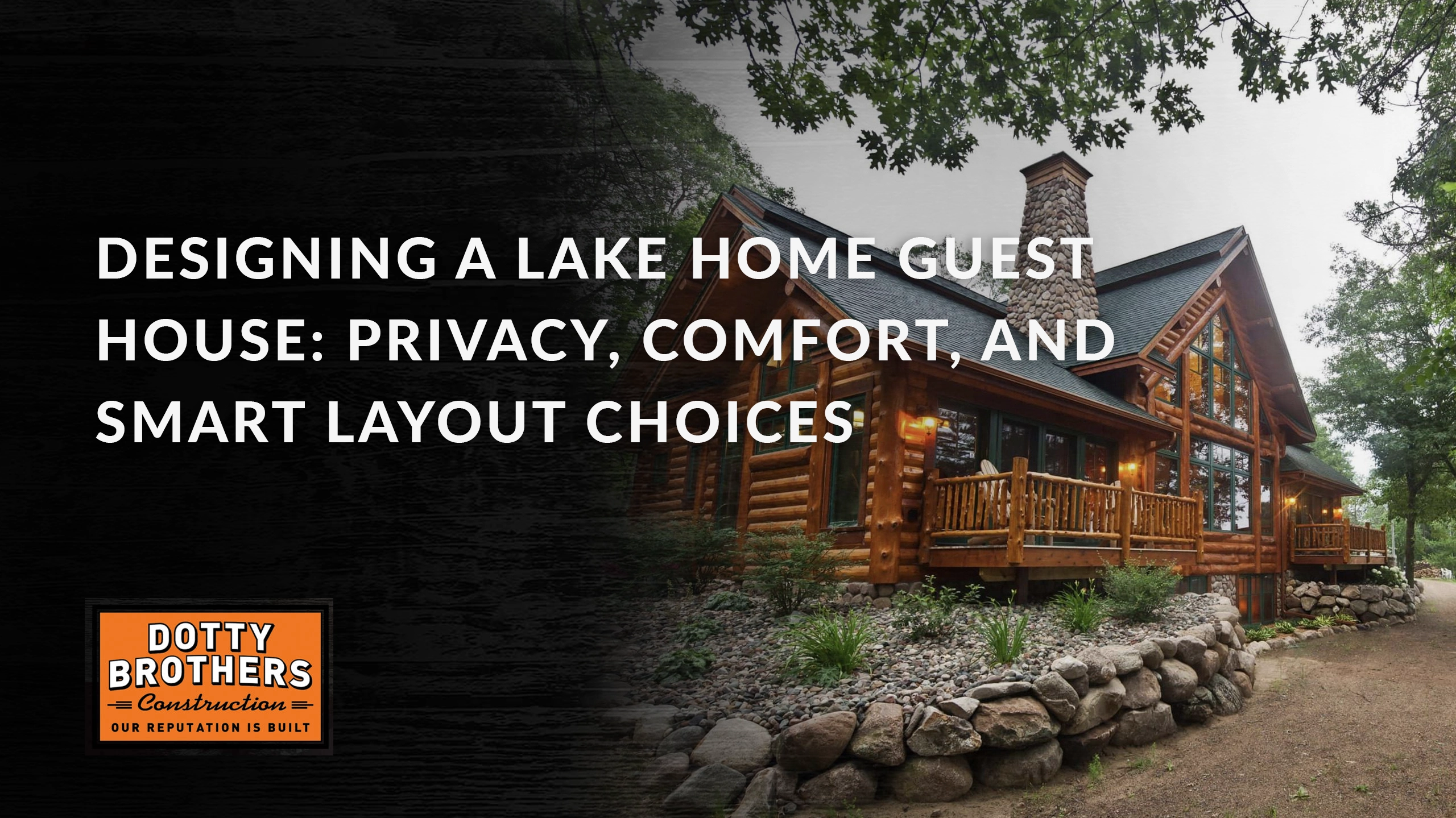

Planning a lake home guest house is one of the most rewarding decisions you can make for your property. Done well, it turns a beautiful lot into a true family destination—a place where cousins can come for a week without crowding the main house, where parents can visit and still feel independent, and where summer weekends stretch into something everyone looks forward to all year.
But getting it right takes more thought than simply adding a small cabin to the property. Layout choices, privacy planning, regulatory requirements, and thoughtful amenities all play a role in whether your guest house becomes a beloved retreat or a source of ongoing frustration. Here is what to keep in mind as you start planning.
Before drawing a single floor plan, it helps to understand the regulatory framework. Minnesota's shoreland management rules set statewide baseline standards for development near lakes and rivers. Under those rules, a guest cottage may not cover more than 700 square feet of land surface and must not exceed 15 feet in height. Your lot must also meet the minimum size requirements for additional dwelling units on the same parcel.
Local ordinances often go further than the state baseline. Crow Wing County, Aitkin County, and other lake-region counties may have their own setback rules, impervious surface limits, and visibility requirements that apply on top of what the DNR mandates. Working with a contractor who knows these local rules from the start saves time and prevents costly design revisions down the road.
One important note: the guest cottage must also be located or designed to reduce its visibility as viewed from public waters—typically through vegetation, topography, setbacks, or exterior color choices. This is not just a rule to check off. It is also an opportunity to nestle the structure naturally into the landscape, giving it a sense of place rather than a look that feels dropped onto the lot.
The most common mistake in guest house planning is treating privacy as secondary to square footage. In practice, privacy is what makes a guest house feel like a true retreat rather than a cramped overflow room. Both your guests and your own family will be happier when each structure has a clear sense of separation.
Thoughtful siting goes a long way. Positioning the guest house at an angle to the main home—rather than directly behind or beside it—breaks the visual and acoustic connection between the two buildings. A stand of trees, a slight grade change, or a planted buffer adds another layer of separation without requiring a fence or hard barrier.
Entry points matter too. When the guest house has its own dedicated path from the driveway or lakeside, guests do not have to pass through the main home's yard or deck to reach their space. That small detail shifts the dynamic considerably. Guests feel like they have arrived somewhere, not just borrowed a corner of someone else's property.
For a guest house in the 400 to 700 square foot range, an open-plan layout almost always outperforms a divided one. A combined sleeping and living area—anchored by a well-designed sleeping nook or lofted bed—feels generous without wasted circulation. A compact but full bathroom is non-negotiable. A small kitchenette with a mini fridge, single-basin sink, and two-burner cooktop lets guests handle their own breakfasts and late-night snacks without depending on the main house.
Ceiling height does a lot of work in a small space. Vaulted ceilings, even in a modest structure, give the interior a sense of breathing room that flat, standard-height ceilings simply cannot replicate. Exposed beams add warmth and texture without taking up floor space. Large windows keep the space feeling connected to the lake setting—one of the main reasons people come to the property in the first place.
Storage is another area where lake guest houses often fall short. Plan for it early. Dedicated hooks for gear, a small closet, and a place to stow kayak paddles or life jackets near the entrance make a real difference in day-to-day livability. Guests who feel organized in their space tend to be more comfortable and less likely to leave clutter drifting toward the main house.
A guest house does not need to be luxurious to feel special. It needs to feel complete. The difference between a guest house guests love and one they merely tolerate often comes down to a handful of small details: good lighting, a comfortable mattress, a reliable Wi-Fi signal, and a screened porch or small deck with a direct lake view.
Outdoor space deserves real investment. Even a 100-square-foot deck facing the water gives guests a place to start their morning with coffee, watch the sunset, or read without heading over to the main house. A fire pit placed between the two structures creates a natural gathering zone that both households can share when the mood calls for it.
Heating and cooling are practical necessities in Minnesota. Shoulder-season visits in May and September can bring cool nights, and a reliable mini-split system handles both heating and cooling efficiently without the maintenance headaches of a forced-air system. Radiant in-floor heat is another excellent option for a slab-on-grade guest cottage—it works quietly underfoot and keeps the structure comfortable even when guests arrive on a chilly fall evening.
A multi-structure lake property works best when the buildings feel intentionally connected rather than randomly placed. Family compound-style layouts allow multiple generations to live in proximity to one another while each household maintains independence and privacy. That balance is the goal: togetherness on purpose, solitude when needed.
Pathways, shared outdoor amenities, and consistent exterior materials help tie the property together visually. When the guest house shares a roofline profile, siding color, or material palette with the main home, the overall property reads as a cohesive design rather than an accretion of mismatched structures. That coherence matters for livability, and it matters for long-term property value as well.
Lighting the path between structures is a detail that is easy to overlook and easy to appreciate once it is in place. Low-voltage path lights or recessed step lights guide guests safely between buildings after dark without creating glare that washes out the night sky—something lake property owners rightly care about.
Designing a guest house on a Minnesota lake property involves more moving parts than a standard residential addition. Shoreland rules, septic system capacity, lot coverage limits, and local zoning all need to be addressed before the foundation is poured. Working with a builder experienced in Minnesota lake construction keeps the process moving and keeps your design grounded in what is actually buildable on your specific lot.
At Dotty Brothers Construction, we help families across Minnesota's lake regions think through exactly these questions. From initial site planning and regulatory research to framing, finish work, and final walkthrough, we bring the same care to a 500-square-foot guest cottage as we do to a full custom home. Your lake property is worth getting right—and a well-designed guest house is one of the best investments you can make in the experience of being there.
Ready to start planning? Reach out to our team today. We would love to hear about your property and help you think through what is possible.

WRITE: info@dotty.com
CALL: +1 (800) 459-3453
FIND US: 4593 Morehouse Drive Pequot Lakes, MN
Your home is built by loyal Dotty Brothers craftsmen — not an assortment of subcontractors. We’re skilled artisans who live by one motto: "Build it as if it’s your own." That mindset shows in every detail, from foundation to finish.
